5 Google Review Removal Methods That Actually Work
Drash Eldetron
Writes about digital privacy, reputation, and online presence.
August 10, 2026
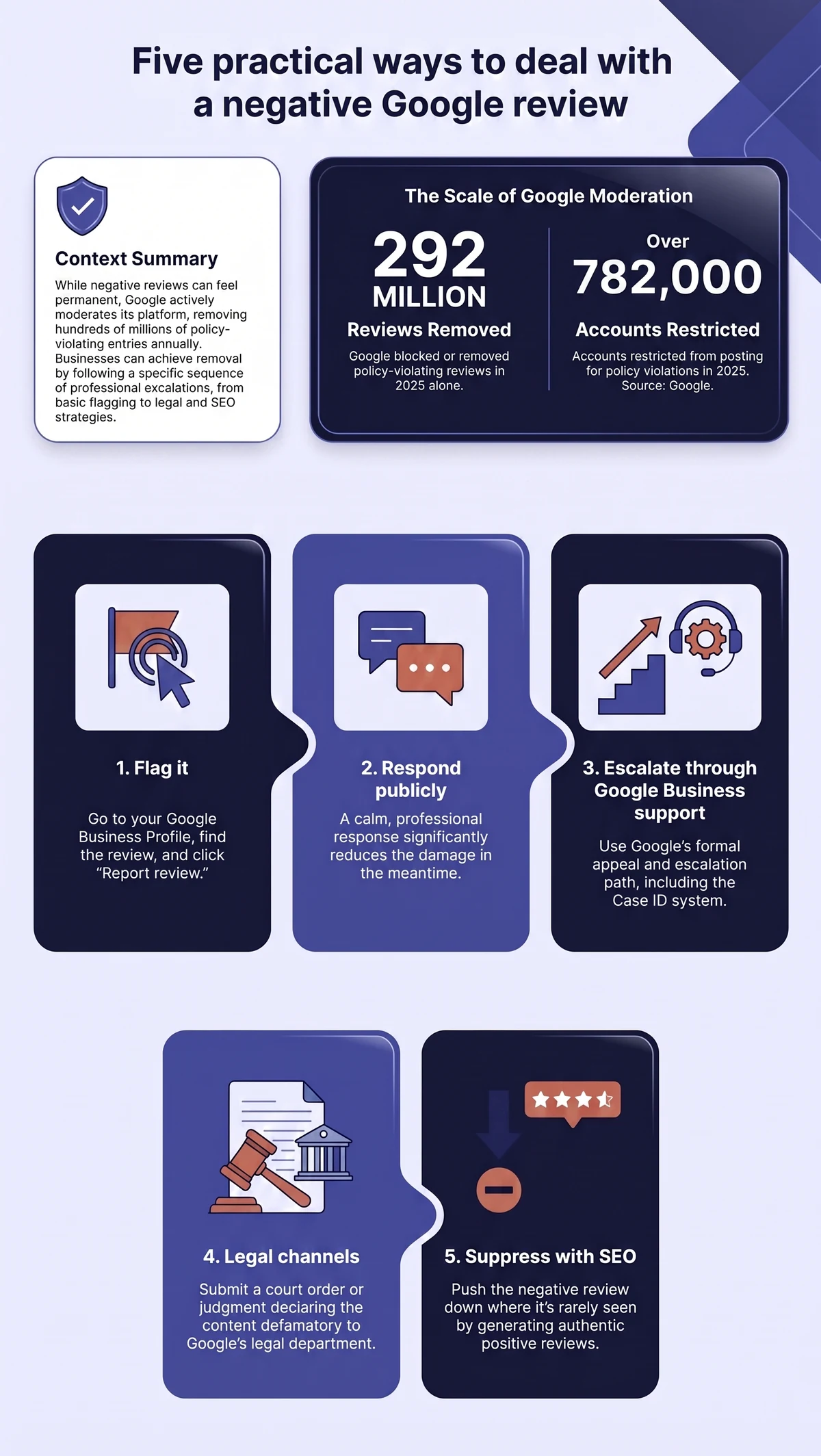
Google reviews feel permanent the moment they post—but Google blocked or removed 292 million policy-violating reviews in 2025 alone. The businesses that get theirs removed almost always use one of five specific approaches, not a random complaint.
Here's what actually works, and when to reach for each one.
Quick overview
- Five practical ways to deal with a negative Google review, from flagging it yourself to legal escalation and SEO suppression — flagging it directly with Google is the fastest first step.
- Google denies most flagging requests for negative-but-legitimate reviews — legal channels work when the review contains false statements you can document.
- If removal fails entirely, SEO suppression pushes the review down where it’s rarely seen.
- Multiple negative reviews, a sudden spike, or reviews you’ve already tried and failed to remove yourself are the clearest signs it’s time for professional help.
The 5 methods that actually work
1. Flag the review directly in Google Maps
The simplest starting point. Go to your Google Business Profile, find the review, and click the three-dot menu → “Report review.” Select the most relevant policy violation.
One category worth checking specifically: conflict of interest. If the reviewer has no history as an actual customer—a competitor, a former employee, someone with an axe to grind—that’s grounds for a stronger flag than a generic complaint.
When it works: Reviews containing hate speech, spam content, explicit personal attacks, obvious fake accounts, or conflict-of-interest reviews from non-customers. Google’s enforcement here is real—in 2025 alone, over 782,000 accounts were restricted from posting for policy violations, and AI-powered moderation now catches many spam and scam patterns before they ever go live.
When it doesn’t: Google denies the vast majority of flagging requests, especially for negative-but-legitimate reviews. This flagging channel doesn’t exist on every platform, either — complaint-publishing sites in particular generally don’t moderate on request at all; see our guide to why if you’re dealing with one of those instead of a Google review.
2. Respond publicly and professionally
Responding won’t influence Google’s removal decision—that’s evaluated purely on policy violations, not on how you handle it—but a calm, professional response significantly reduces the damage in the meantime. It:
- Shows potential customers you take feedback seriously
- Often causes the reviewer to remove or update the review voluntarily
- Demonstrates that you addressed the issue
Template: “Thank you for your feedback. We’re sorry to hear about your experience. We’ve looked into this and [action taken]. We’d love the opportunity to make this right—please reach out to [contact] directly.”
3. Escalate through Google Business support
If the standard flagging process fails, Google has a formal appeal and escalation path—including a Case ID system and forum escalation to Product Experts, Google’s higher-tier reviewers for review disputes. We break down the exact process, what evidence works, and what happens at each stage in our full Google review removal guide.
4. Request removal via legal channels
If a review contains false statements of fact (not just negative opinions) you can document, legal action against the reviewer—not Google directly—is the real path. Google generally won’t remove a review just because a business disputes it or sends a demand letter; it typically requires a court order or judgment declaring the content defamatory, which you then submit to Google’s legal department.
It’s a slower, more expensive route than flagging, reserved for cases with real evidence and real damages. Section 230 is the reason this legal path looks the way it does — see our guide to the legal reality behind review removal generally for why a court order aimed at the reviewer, not Google, is what actually moves things.
5. Suppress it with positive reviews and SEO
If removal fails entirely, the next best option is suppression. The goal: push the negative review down where it’s rarely seen.
This involves:
- Generating authentic positive reviews through ethical request campaigns
- Building positive content that outranks the negative review
- SEO strategies that promote your owned properties above review aggregators
This is the same SERP suppression process used for other kinds of negative content — the mechanics don’t change just because the source is a review.
When to hire a professional
Consider professional help when:
- You have multiple negative reviews, not just one
- The reviews appear coordinated (a sudden spike of 1-star reviews)
- Direct flagging has been denied multiple times
- The reviews contain genuinely false statements you can document
- The reputation damage is affecting real revenue
Professional review removal services have established relationships with platform policy teams, legal resources for demand letters, and technical tools that significantly improve removal rates.
Need help removing a specific review? Our Google review removal service handles the flagging, appeal, and escalation directly, or get a free assessment.
Frequently asked questions
Does responding to a negative review affect whether Google removes it?
No. Google evaluates removal purely on policy violations, not on how a business responds. But a calm, professional public response still matters — it reduces reputational damage in the meantime and often prompts a reviewer to update or remove the review voluntarily.
What is the "Product Experts" escalation Google offers if a flag gets denied?
It's Google's formal appeal path beyond standard flagging — a Case ID system with escalation to Product Experts, higher-tier reviewers who handle review disputes when the initial flag is denied.
Do I need a lawyer to get a false review removed through legal channels?
Generally, yes, for the formal path. Google typically requires an actual court order or judgment declaring the content defamatory before it will act, which means the case has to go through the legal system first, not just a demand letter sent directly to Google.
Is there a specific type of review Google's own moderation is most reliable at catching?
Conflict-of-interest reviews — from a competitor, a former employee, or someone with no history as an actual customer — tend to get a stronger response from flagging than a generic complaint, since that's a clearer, checkable policy violation.
Prefer not to do this yourself?
We can take it from here
If the steps above don't get you the result you need, tell us what's going on and we'll take a look.
Get in touch